How Does Robert Smithsonã¢ââ¢s Spiral Jetty Subvert the Traditional Role of Art?
One of the leading proponents of Land Art, Robert Smithson initially flirted with Pop Art by creating hybrid collages made of various elements. He soon became preoccupied with Minimalism, and was affiliated with artists belonging to the Main Structures move, such equally Nancy Holt (who became his married woman a few years later), Robert Morris and Sol LeWitt. Effectually 1967, Smithson became interested in sculpture in the expanding field, a term proposed by fine art critic Rosalind Krauss in 1979, which led him to createone of the pioneering and large scale interventions in the natural environs - the iconic Screw Jetty in 1970.
Earlier we come to closer to analyzing this land art masterpiece, it is mandatory to examine Smithson's practice in the context of the seventh decade of the by century. Namely, the discontent with social and political circumstances on a global scale resulted in the student protests in 1968 which nurtured a generation of young people willing to change their societies in a quest for a ameliorate world. The student demands were in sync with a broader social climate framed by the Civil Rights movement, and later feminist, LGBTQ and environmentalist movements. Naturally, all of those progressive politics reflected on visual arts, and eventually resulted in the appearance of conceptual fine art, the leading artistic phenomenon of the 1970s.
At the aforementioned fourth dimension appeared a new fine art movement based on environmentalism and an approach similar to the i of Conceptualism. The leading thought behind Land Fine art wasthe use of natural materials such as soil, rocks, vegetation, and h2o. All of the elements were constitute in the natural surround and were composed in specific formations, aimed to remain exposed to atmospheric conditions and potential changes in the mural. These interventions were usually documented with the photo camera, and the photographs of the works were then displayed in an exhibition space. The movement was even promoted in a pic made by a German language filmmaker Gerry Schum, featuring both American and European artists and their works released in rural sites; the film was transmitted on an contained television called Sender Freies in 1969.
One of the finest examples of Country Art was indeedSpiral Jetty, constructed in April 1970 according to the concept of Robert Smithson. Information technology was made of mud, salt crystals, and basalt rocks on the northeastern shore of the Bully Table salt Lake nearly Rozel Point in Utah. To be more precise the work, which is 1,500 feet (460 one thousand) long and fifteen feet (4.six 1000) wide, forms a counterclockwise coil jutting from the shore of the lake.
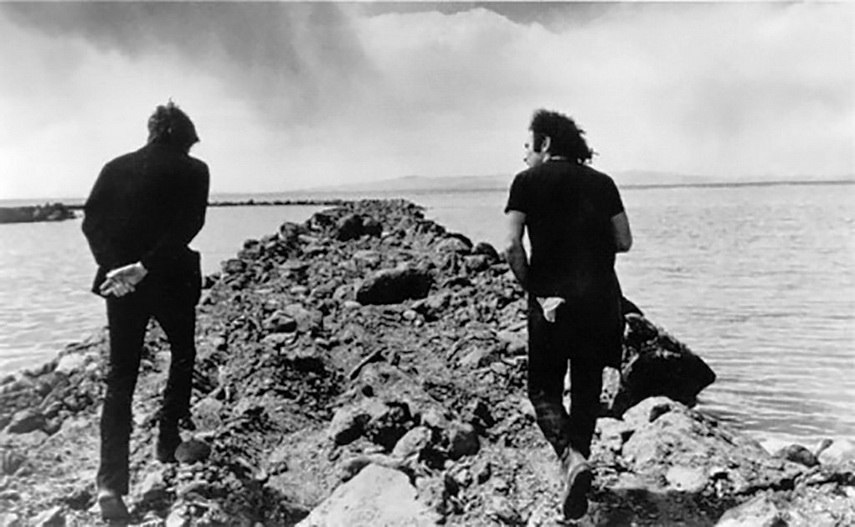
Spiral Jetty by Robert Smithson - From An Idea To Realization
Smithson explained that the location in Utah was called because of the blood-blood-red colour of the water and its connection with the primordial bounding main. The table salt-tolerant leaner and algae turned the h2o ruby; the lake consists of 27 per centum salinity in its northern function which is an effect of the lack of freshwater sources. Some other reason for the selection of the Rozel Indicate site was the creative person's fascination with its desolate beauty - an old pier, few unused oil rigs and industrial remnants from nearby Gilt Spike National Celebrated Site.
In order to transfer the rocks into the lake, Smithson hired a contractor Bob Phillips, who was a construction expert and was quite efficient in projecting the price and endeavor required for delivering the project. Allegedly, the artist took some time to pursue the contractor to accept the unusual proposal. In order to produce Spiral Jetty, Smithson had to require the approval of land rights and earthmoving equipment.
The works began in April 1970, and Phillips used heavy mechanization to pull 6,650 tons of rock and world into the lake. The projection was conducted in two phases - the first lasted six days. Smithson decided to reshape the constellation, meaning that 7,000 tons of basalt rock had to be moved, so three more days were added. Finally, the spiral shape as nosotros know it today was made, despite the fact Phillips was not very fond about using the equipment in the mud effectually the Rozel Betoken. All the same, both the artist and the contractor were satisfied and they used the term "entropy" to describe the interaction of the lake and the basalt.
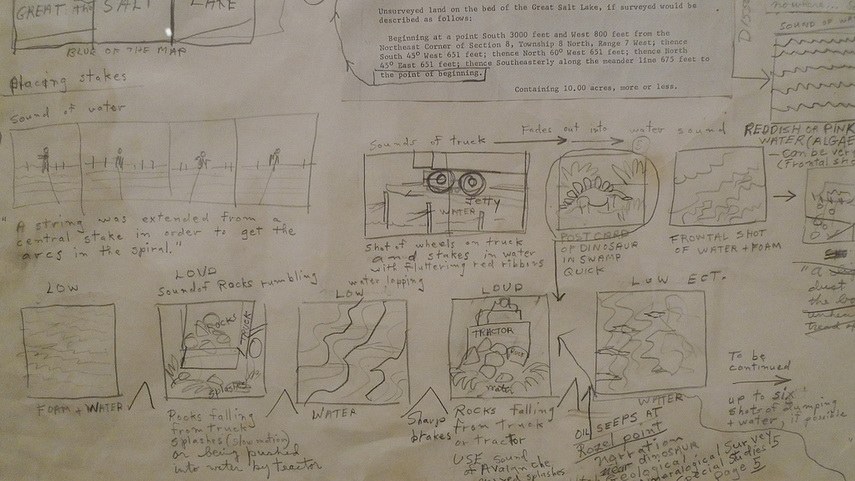
The Spiral Jetty on Film
The construction of Spiral Jetty was documented on a 32-minute colour motion picture, written and directed by Robert Smithson and his married woman Nancy Holt and funded by Douglas Christmas and Virginia Dwan. Information technology was made to give a portrait of the artist and the concept of the work based on his interest in geology, paleontology, astronomy, mythology, and picture palace. The sequences of the Jetty construction are contrasted with the footage of dinosaurs in a natural history museum and the ripped pages from a history text. The artist's narration emphasizes his standpoints, and he claims that "the globe's history seems at times like a story recorded in a book, each page of which is torn into pocket-sized pieces. Many of the pages and some of the pieces of each page are missing."
As a affair of fact, Smithson reinterpreted the historical soapbox by proposing a new paradigm of artwork outside of an art institution. The sequences shot from a helicopter was an effect of his desire to recapitulate the scale of the jetty aimed to achieve the impression of the artwork outside the categories of time and place.
Robert Smithson, Screw Jetty 1970, Neat Salt Lake Utah
The Legacy of a Pioneering Land Art Intervention in Utah
The artwork is noted equally one of Smithson's all-time. Unfortunately, three years after creating it, the artist died in a helicopter crash in Texas. In 1999, the creative person Nancy Holt, Smithson'due south wife, and the Estate of Robert Smithson, decided to donate Spiral Jetty to the Dia Art Foundation. This independent organization obliged to take intendance of the work and maintains the charter of Utah sovereign lands in the Cracking Common salt Lake.
During that time, Spiral Jetty was fully submerged in the lake; n the early on 2000s, nonetheless, drought acquired water levels to lower, so Spiral Jetty became visible for the outset prolonged flow in its history. Such a natural shift resulted in an increasing popularity of the artwork, so a great number of visitors come to run across it.
Robert Smithson gave several ambiguous statements apropos entropy and his intent for the work to mimic earthly attributes so that the elements are left to dissolve naturally which makes preservation process very complicated. Whichever is the fate of the Spiral Jetty, this item state fine art intervention or sculpture has definitely marked the showtime of a new era and launched an entirely new perception of the function and the meaning of an artwork.


In 1970 Robert Smithson (1938-1973), one of the almost innovative and provocative artists of the twentieth century, created the landmark earthwork Screw Jetty at Rozel Signal on Utah's Great Table salt Lake. This dramatic and highly influential work forms a coil one,500 feet long and 15 feet broad and stretches out counterclockwise into the lake's translucent red h2o. Equanimous of black basalt rocks and globe, the sculpture comprises the materials of its location: mud, salt crystals, rocks, h2o. The contributors to this comprehensive publication consider the sculpture in relation to its eponymous companions—a text work and a film. These essays situate this renowned series of works alongside Smithson's critical writings, proposals, drawings, sources, and models.
Featured images: Robert Smithson - Screw Jetty, 1970, by Retis image via Flickr; Spiral Jetty, via Wikipedia; Image past Donald Fodness via Flickr; Spiral Jetty via Flickr.
doughertynink1944.blogspot.com
Source: https://www.widewalls.ch/magazine/spiral-jetty-robert-smithson-utah
0 Response to "How Does Robert Smithsonã¢ââ¢s Spiral Jetty Subvert the Traditional Role of Art?"
Post a Comment